Fenbendazole Research Updates: 2026 Overview

Few compounds have generated as much online discussion in recent years as Fenbendazole . Originally developed as a veterinary antiparasitic medication, fenbendazole has attracted attention far beyond its traditional use due to a growing body of laboratory research examining its effects on cellular processes.
The increasing public interest has led many people to ask important questions: What does the latest research show? Have any major breakthroughs occurred? Are scientists actively studying fenbendazole in new ways?
This article explores the most significant Fenbendazole Research updates, scientific findings, and future directions shaping discussions in 2026.
Pharmacy9, our goal is to help readers stay informed by providing balanced, evidence-based coverage of emerging health and research topics.
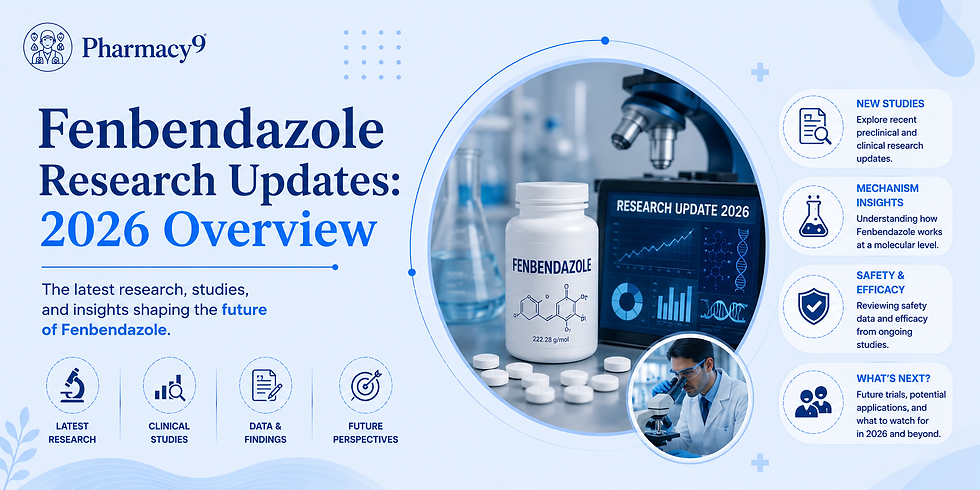
What Is Fenbendazole?
Fenbendazole belongs to a class of medications known as benzimidazole antiparasitic agents. It has been widely used in veterinary medicine to treat intestinal parasites in animals.
Its primary mechanism involves disrupting microtubule formation within parasitic organisms, preventing them from functioning normally.
Over time, scientists discovered that microtubules also play important roles in cellular division and growth, leading researchers to explore additional biological effects beyond parasite control.
This scientific curiosity helped spark the modern wave of Fenbendazole Research .
Why Researchers Are Interested in Fenbendazole
The growing interest stems from observations made in laboratory experiments.
Researchers have investigated whether fenbendazole may influence:
Cellular metabolism
Microtubule dynamics
Cell division processes
Oxidative stress pathways
Immune system interactions
These findings have encouraged further exploration into how the compound behaves under controlled research conditions.
However, it is important to recognize that laboratory observations do not automatically translate into proven benefits in humans.
Major Research Areas in 2026
Several key areas continue attracting scientific attention.
Cellular Mechanism Studies
Researchers remain focused on understanding how fenbendazole interacts with cellular structures.
Recent investigations have examined:
Tubulin binding activity
Cell-cycle regulation
Energy production pathways
Stress-response signaling
By identifying these mechanisms, scientists hope to better understand where future research may lead.
Drug Repurposing Research
One of the most active fields involves Drug Repurposing .
Drug repurposing occurs when researchers evaluate existing medications for potential new applications.
Advantages include:
Existing safety data in original use cases
Lower development costs
Faster research timelines
Established manufacturing processes
Fenbendazole has become one of many compounds evaluated within this broader scientific strategy.
Combination Therapy Investigations
Researchers have also explored how fenbendazole behaves when studied alongside other compounds in laboratory models.
Areas of interest include:
Synergistic cellular effects
Pathway interactions
Metabolic responses
Experimental treatment frameworks
These studies remain largely preclinical and require further validation.
Research Snapshot Table
Research Area | Current Status in 2026 |
Antiparasitic Use | Well established in veterinary medicine |
Cellular Mechanism Research | Active laboratory investigation |
Drug Repurposing Studies | Ongoing preclinical exploration |
Cancer Research Applications | Early-stage and limited evidence |
Human Clinical Trials | Limited availability |
Long-Term Human Data | Insufficient evidence |
Fenbendazole and Cancer Research
One of the most widely discussed topics involves Cancer Research .
Researchers have explored whether fenbendazole may affect:
Tumor cell growth
Cellular division pathways
Metabolic functions
Microtubule-dependent processes
Laboratory findings have generated scientific interest because some observed mechanisms overlap with pathways investigated in oncology research.
Important Scientific Context
While laboratory studies can provide valuable insights, they represent only one step in the research process.
Before any therapy can be considered effective for human use, researchers typically require:
Laboratory evidence
Animal studies
Human clinical trials
Safety evaluations
Regulatory review
As of 2026, researchers continue emphasizing the need for stronger human evidence before drawing conclusions regarding clinical effectiveness.
Challenges Facing Future Research
Despite growing interest, several obstacles remain.
Limited Human Data
One of the largest challenges is the lack of large-scale human clinical studies.
Without comprehensive clinical evidence, it becomes difficult to determine:
Effectiveness
Optimal dosing
Long-term safety
Potential interactions
Funding and Research Priorities
Scientific resources are finite.
Researchers must prioritize studies based on available funding, public health needs, and potential impact.
This influences how quickly investigations progress.
Translating Laboratory Findings
Many compounds demonstrate promising results in laboratory environments but fail to produce similar outcomes in human studies.
This is a common challenge throughout biomedical research.
Emerging Scientific Questions
Researchers entering 2026 continue exploring several unanswered questions.
These include:
Which cellular pathways are most strongly affected?
Are observed effects reproducible across multiple models?
What factors influence variability between studies?
Can specific biomarkers predict responses?
Which research methods provide the most reliable data?
Answering these questions may help guide future investigations.
Understanding Research Limitations
Scientific progress depends on recognizing both findings and limitations.
Current limitations include:
Small sample sizes in some studies
Limited human data
Variability between research models
Differences in study design
Incomplete long-term information
Understanding these limitations helps readers interpret headlines more critically and avoid overstating conclusions.
The Role of Evidence-Based Research
The scientific method relies on careful validation.
Researchers generally evaluate new findings through:
Reproducibility
Peer review
Independent verification
Clinical testing
Long-term observation
This process helps distinguish preliminary observations from established scientific knowledge.
For compounds receiving increased public attention, maintaining an evidence-based perspective remains especially important.
What Experts Are Watching in 2026
Scientists monitoring fenbendazole research are particularly interested in:
New laboratory publications
Mechanism-of-action discoveries
Drug repurposing initiatives
Biomarker research
Potential clinical investigations
Future studies may provide greater clarity regarding the compound's biological effects and potential research applications.
"Scientific progress is rarely driven by a single study. Meaningful conclusions emerge through repeated investigation, verification, and careful analysis."
Conclusion
The story of Fenbendazole research continues to evolve in 2026. While the compound remains well known for its veterinary antiparasitic role, scientific interest has expanded into broader investigations involving cellular biology, Drug Repurposing strategies, and Cancer Research pathways.
Pharmacy9, we believe readers benefit most from balanced, evidence-based information. Current findings remain largely centered on laboratory and preclinical research, and significant questions still require further study. As researchers continue exploring fenbendazole's biological mechanisms, future investigations may provide deeper insights into its potential applications and limitations.
For now, the most responsible approach is to follow emerging research with curiosity while recognizing the difference between preliminary findings and established clinical evidence.
Readers interested in additional research updates, health insights, and educational resources can explore more content available through Pharmacy9.


FAQ Section
1: What is fenbendazole primarily used for?
Fenbendazole is primarily used in veterinary medicine to treat parasitic infections in animals.
2: Why has fenbendazole gained research attention?
Researchers have been studying its effects on cellular processes, microtubules, and metabolic pathways in laboratory settings.
3: Is fenbendazole approved for cancer treatment?
No. As of 2026, fenbendazole is not approved as a cancer treatment by major regulatory authorities.
4: What is drug repurposing?
Drug repurposing involves investigating existing medications for potential new applications beyond their original approved uses.
5: Are there human clinical trials on fenbendazole?
Human clinical evidence remains limited, and additional research is needed to establish safety and effectiveness for new applications.
6: What should readers focus on when reviewing new research?
Readers should consider study quality, sample size, reproducibility, and whether findings come from laboratory, animal, or human research.
Comments